
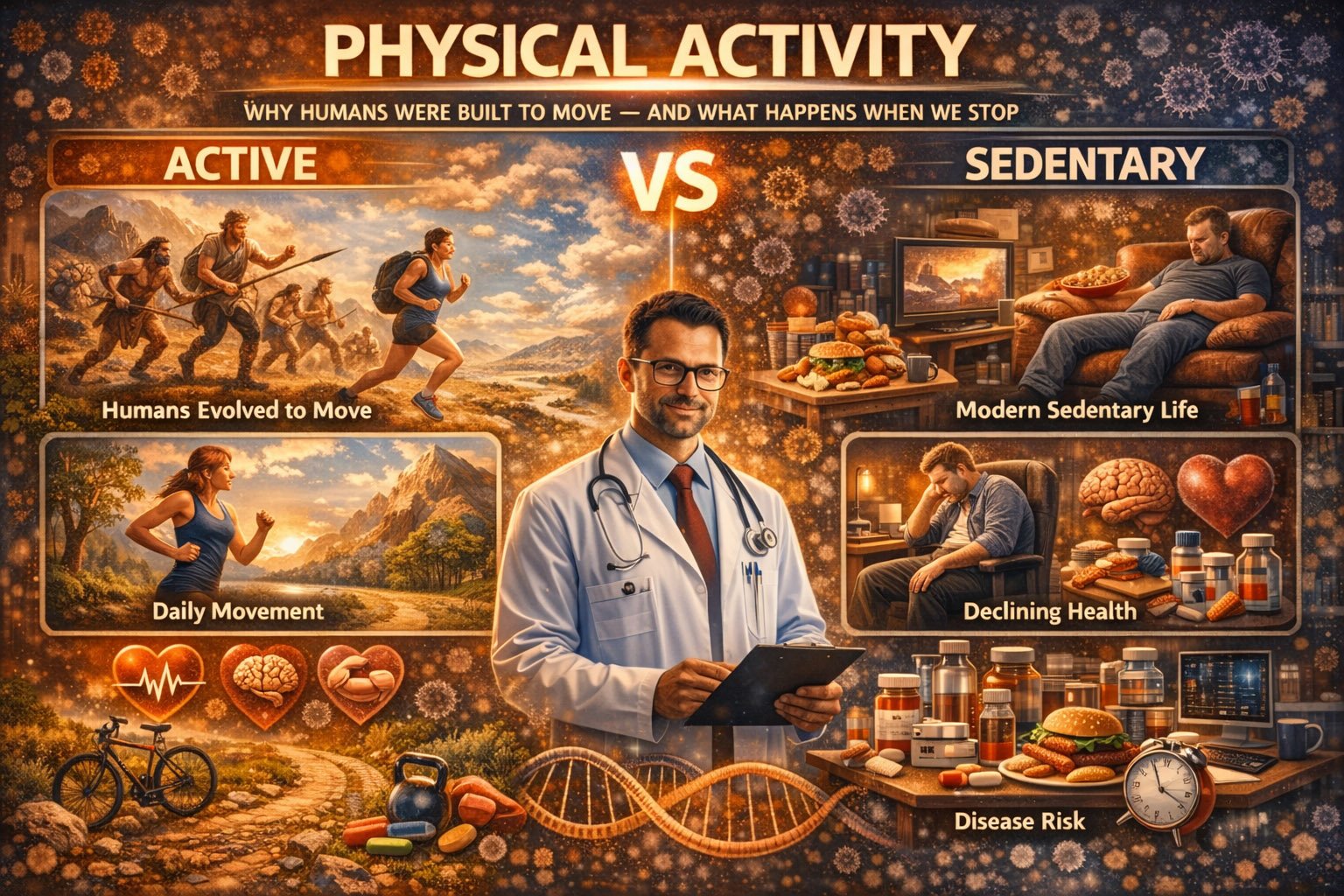
Physical Activity: Why Humans Were Built to Move — and What Happens When We Stop
VitaCoreBalance Editorial Team | Research-based health content • Editorial review process | March 2026
For most of human history, movement was not a lifestyle choice — it was a biological necessity. Long before gyms, fitness trackers, or structured exercise routines existed, physical activity was inseparable from survival. Humans walked long distances, climbed, carried, hunted, gathered, built shelters, and constantly adapted to changing environments. Movement shaped our bodies, our brains, and even our psychology.
Today, however, a profound shift has occurred. In just a few generations — a tiny fraction of evolutionary time — daily life has become dramatically more sedentary. Cars replaced walking, machines replaced manual labor, and screens replaced physical engagement with the world. This transformation has brought comfort and efficiency, but it has also introduced a new set of health risks that our biology was never designed to handle.
Understanding physical activity is not simply about fitness or weight control. It is about recognizing a fundamental truth: humans are movement-dependent organisms. Our bodies function best when they move regularly, and our health — both physical and psychological — depends on it.
Humans Evolved as Endurance Movers
Anthropological and evolutionary evidence strongly suggests that humans are uniquely adapted for sustained physical activity. Unlike many animals that rely on bursts of speed, humans developed the ability to move efficiently over long distances. This capability was essential for hunting, migration, exploration, and survival.
Early humans routinely walked between 8 and 16 kilometers (5 to 10 miles) per day, often while carrying tools, food, or children. Movement was not exercise — it was life itself.
Key evolutionary adaptations supporting human movement include:
- Upright posture and bipedal walking
- Highly efficient energy metabolism
- Large gluteal muscles for endurance
- Flexible joints and shock-absorbing feet
- Advanced thermoregulation through sweating
- A brain wired to respond positively to physical activity
These features did not evolve randomly. They developed because movement improved survival, reproduction, and resilience.
In other words, the human body is not optimized for rest — it is optimized for motion.
The Sedentary Revolution: A Very Recent Change
For approximately 99% of human history, daily life required continuous physical effort. The transition toward sedentary living is extremely recent, occurring mainly during the last 150 to 200 years with the Industrial Revolution and accelerating dramatically in the digital age.
Today, many people spend:
- 6 to 10 hours sitting each day
- Minimal time walking
- Little exposure to physically demanding tasks
- Long periods indoors
- Significant time using screens
From an evolutionary perspective, this shift happened almost instantly. Our genes have not had time to adapt to a sedentary environment.
This mismatch between biology and lifestyle is often referred to as:
Evolutionary mismatch
It helps explain why many modern health problems are strongly associated with inactivity.
The Physical Consequences of Inactivity
A sedentary lifestyle affects nearly every system in the body. Physical inactivity is now considered one of the leading risk factors for chronic disease worldwide.
Common physical consequences include:
Cardiovascular Problems
Lack of movement reduces cardiovascular efficiency and increases the risk of:
- High blood pressure
- Heart disease
- Stroke
- Poor circulation
Regular movement strengthens the heart and improves blood vessel function.
Metabolic Disorders
Physical inactivity disrupts metabolism and energy regulation.
This increases the risk of:
- Type 2 diabetes
- Insulin resistance
- Obesity
- Fat accumulation in the liver
Muscles play a major role in glucose regulation. When muscles are inactive, blood sugar control becomes less efficient.
Musculoskeletal Decline
Without regular movement, the body begins to weaken.
This includes:
- Loss of muscle mass
- Reduced bone density
- Joint stiffness
- Chronic back and neck pain
- Increased risk of injury
Movement is essential for maintaining structural integrity.
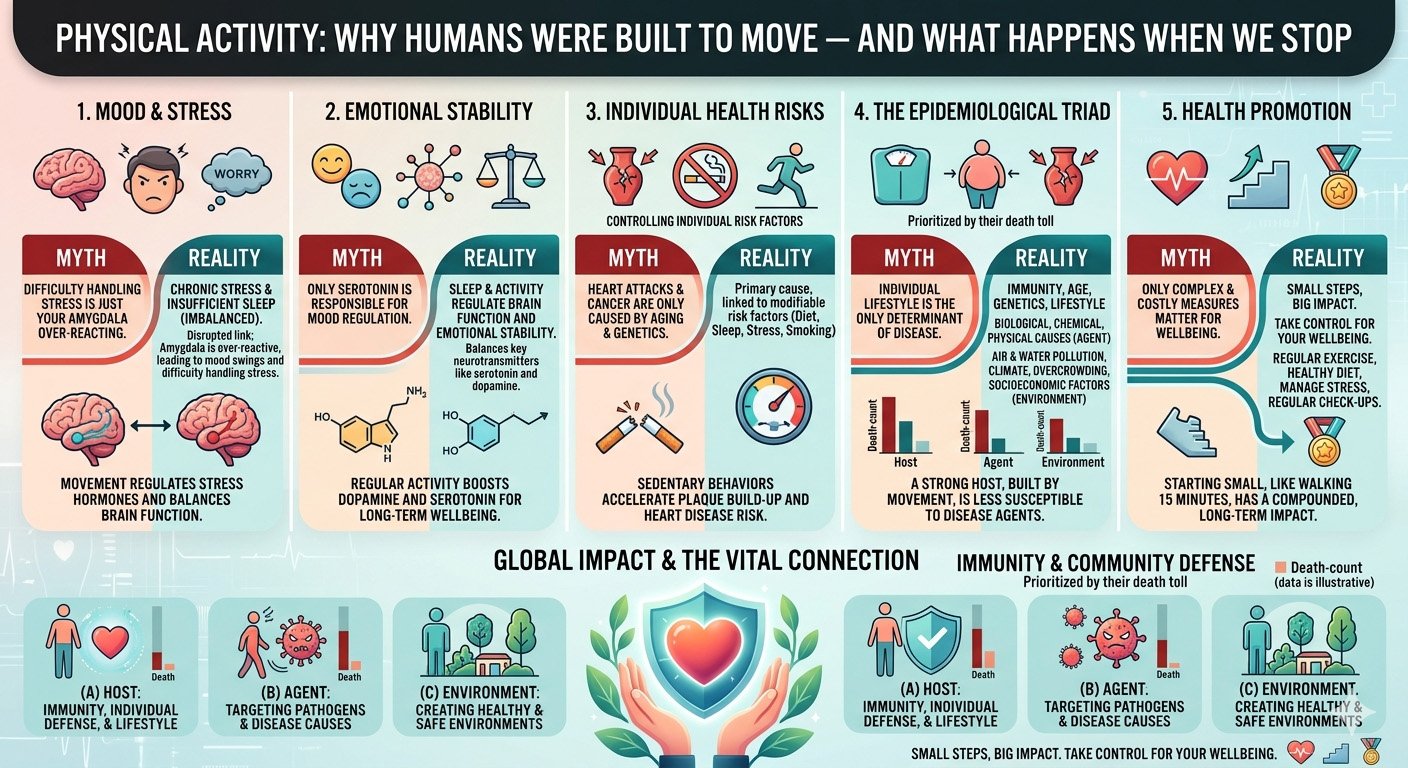
Reduced Longevity
Large population studies consistently show that low physical activity is associated with:
- Higher mortality risk
- Shorter lifespan
- Reduced quality of life
Physical activity is one of the most powerful predictors of healthy aging.
The Psychological Effects of Movement — and Stillness
Physical activity is not only a physical requirement. It is also a neurological and psychological necessity.
The human brain evolved in a moving body.
Movement stimulates the release of important brain chemicals, including:
- Endorphins
- Dopamine
- Serotonin
- Brain-derived neurotrophic factor (BDNF)
These substances support:
- Mood regulation
- Motivation
- Learning and memory
- Stress resilience
- Emotional stability
When movement decreases, mental health often suffers.
Sedentary Behavior and Mental Health
Research consistently links physical inactivity with:
- Depression
- Anxiety
- Cognitive decline
- Chronic fatigue
- Poor sleep quality
Even modest increases in physical activity can significantly improve psychological well-being.
Movement acts as a natural regulator of the nervous system.
Exercise as Preventive Medicine
Modern medicine increasingly recognizes physical activity as a powerful form of prevention — sometimes more effective than medication for certain conditions.
Regular exercise is associated with reduced risk of:
- Heart disease
- Type 2 diabetes
- Stroke
- Certain cancers
- Dementia
- Depression
- Osteoporosis
In many cases, the benefits are dose-dependent: more consistent movement leads to better outcomes.
However, the threshold for benefit is surprisingly low.
Even moderate activity provides measurable health improvements.
How Much Movement Do Humans Actually Need?
Health organizations around the world generally recommend:
150 to 300 minutes of moderate physical activity per week
or
75 to 150 minutes of vigorous activity per week
This translates to roughly:
- 30 to 45 minutes of movement per day
- Plus muscle-strengthening activities 2 times per week
But these guidelines represent minimum thresholds — not optimal levels.
Historically, humans moved for several hours each day.
The goal is not perfection.
The goal is regular movement.
Small Movements Matter More Than Intense Workouts
One of the most important insights from modern research is that health depends more on total daily movement than on occasional intense exercise.
For example:
- Walking regularly is highly protective
- Standing frequently reduces health risks
- Light activity throughout the day improves metabolism
- Breaking up long sitting periods is beneficial
Even small changes can produce meaningful effects.
Examples include:
- Taking the stairs
- Walking after meals
- Stretching during work
- Standing instead of sitting
- Doing household tasks
- Spending time outdoors
Consistency is more important than intensity.
Movement and Aging
Physical activity is one of the strongest predictors of healthy aging.
Regular movement helps preserve:
- Muscle strength
- Balance
- Mobility
- Cognitive function
- Independence
It also reduces the risk of:
- Falls
- Frailty
- Disability
- Memory decline
In many ways, movement slows the biological aging process.
People who remain physically active tend to maintain function and autonomy much longer than those who are sedentary.
The Body Remembers Movement
One of the most encouraging facts about physical activity is that the body responds quickly to change.
Even after years of inactivity, improvements can occur within weeks.
Common early benefits include:
- Increased energy
- Better sleep
- Improved mood
- Reduced stress
- Enhanced concentration
- Lower blood pressure
The human body is remarkably adaptable.
It was built to move — and it responds when movement returns.
Reconnecting With Our Biological Design
Modern life has made movement optional, but biology has not changed. The human body still expects regular physical activity, just as it did thousands of years ago.
Physical activity is not simply a tool for fitness.
It is:
- A biological requirement
- A neurological regulator
- A metabolic stabilizer
- A psychological support system
- A foundation of long-term health
In the broad story of human evolution, movement is the rule — and sedentary living is the exception.
Returning to regular movement is not about becoming an athlete.
It is about restoring a natural behavior that has always defined what it means to be human.
Medical Disclaimer
This content is for informational purposes only and does not constitute medical advice. Always consult a qualified healthcare professional.
Editorial Transparency
This article was created following evidence-based health content guidelines and reviewed by the VitaCoreBalance Editorial Team.
Sources
- Physical Activity – World Health Organization (WHO)
- Physical Activity Fact Sheet – World Health Organization (WHO)
- Physical Activity Guidelines for Adults – WHO Europe
- Health Benefits of Physical Activity – WHO Eastern Mediterranean Region
- Health Benefits of Physical Activity: A Systematic Review – PubMed
- Physical Activity and Noncommunicable Diseases Prevention – World Health Organization (WHO)