
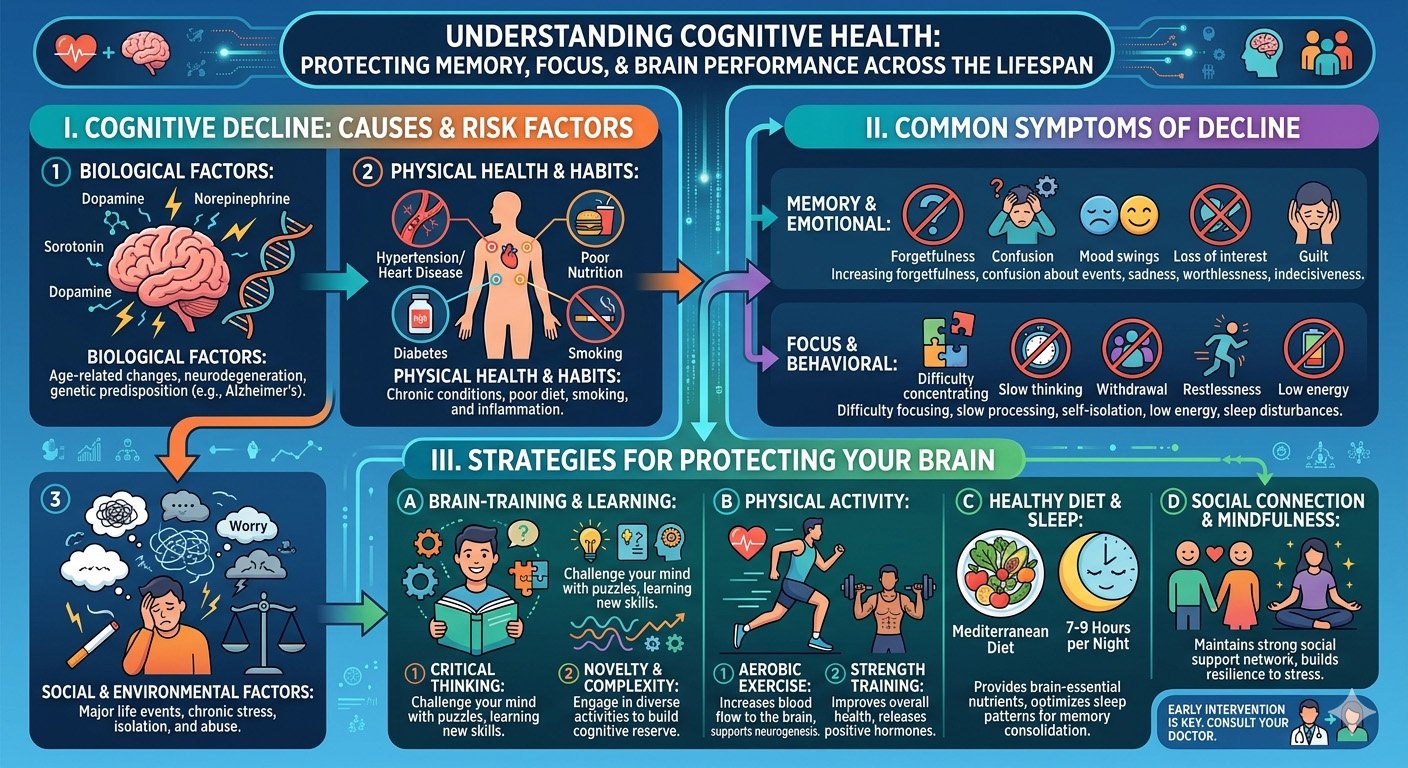
Cognitive Health: Protecting Memory, Focus, and Brain Performance Across the Lifespan
VitaCoreBalance Editorial Team | Research-based health content • Editorial review process | March 2026
Cognitive health refers to the brain’s ability to think clearly, learn efficiently, remember information, solve problems, and maintain mental agility throughout life. It encompasses a wide range of mental processes, including attention, memory, language, reasoning, and decision-making. These functions are not static. They evolve across the lifespan and are influenced by biological aging, lifestyle habits, environmental exposures, emotional health, and medical conditions.
In modern societies, cognitive health has become a central public health concern. Longer life expectancy means more individuals are living into older age, increasing the importance of preserving brain function and preventing cognitive decline. At the same time, younger populations are experiencing rising levels of mental fatigue, digital overload, chronic stress, and sleep disruption—factors that can impair cognitive performance even in early adulthood.
Protecting cognitive health is therefore not only about preventing dementia. It is about sustaining attention, memory, creativity, and mental resilience across all stages of life.
What Is Cognitive Health?
Cognitive health represents the brain’s capacity to process information, adapt to new challenges, and maintain mental clarity. It involves multiple interconnected systems working together to support daily functioning.
Core cognitive functions include:
Memory
The ability to store and retrieve information.
Attention
The capacity to focus on specific tasks or stimuli.
Executive Function
Skills related to planning, organization, and decision-making.
Language
Understanding and producing speech and written communication.
Processing Speed
The rate at which the brain interprets and responds to information.
These functions rely on healthy neural circuits, balanced neurotransmitters, and efficient communication between brain regions. When these systems are disrupted, cognitive performance declines.
How the Brain Changes Across the Lifespan
The brain undergoes continuous structural and functional changes from childhood through older adulthood. Some changes are normal aspects of aging, while others reflect disease processes.
Childhood and Adolescence
During early life, the brain develops rapidly. Neural connections form at an extraordinary rate, supporting learning and emotional development. The prefrontal cortex—responsible for impulse control and decision-making—continues to mature into early adulthood.
Key characteristics of this stage:
- High neuroplasticity
- Rapid learning capacity
- Sensitivity to environmental influences
- Development of executive function
Healthy nutrition, sleep, and education play critical roles during this period.
Adulthood
In adulthood, the brain stabilizes but remains adaptable. Cognitive abilities such as reasoning, vocabulary, and problem-solving often peak during midlife.
However, modern stressors can impair cognitive performance even in otherwise healthy adults.
Common cognitive challenges in adulthood include:
- Mental fatigue
- Reduced attention span
- Memory lapses
- Difficulty multitasking
- Reduced productivity
These changes are often linked to lifestyle factors rather than aging itself.
Older Age
In later life, gradual changes in brain structure and function become more noticeable. Some slowing of processing speed and memory retrieval is considered normal. However, significant cognitive decline is not inevitable.
Healthy aging depends on maintaining neural connectivity and protecting brain cells from damage.
Risk factors for cognitive decline include:
- Cardiovascular disease
- Diabetes
- Chronic stress
- Sleep disorders
- Social isolation
- Sedentary lifestyle
Understanding these risk factors is essential for prevention.
The Biology of Memory and Attention
Memory and attention rely on coordinated activity across several brain regions.
Key brain structures include:
Hippocampus
Responsible for forming new memories.
Prefrontal Cortex
Controls attention, planning, and decision-making.
Amygdala
Processes emotional information and influences memory.
Parietal Lobes
Support spatial awareness and sensory integration.
These regions communicate through networks of neurons that transmit electrical and chemical signals. Efficient communication supports learning and concentration. Disruptions in these networks can impair cognitive performance.
Neuroplasticity: The Brain’s Ability to Adapt
One of the most important discoveries in neuroscience is neuroplasticity—the brain’s ability to reorganize and form new neural connections throughout life.
Neuroplasticity allows the brain to:
- Learn new skills
- Recover from injury
- Adapt to new environments
- Strengthen memory
- Improve attention
This capacity means that cognitive decline is not inevitable. The brain remains capable of change at any age.
Activities that support neuroplasticity include:
- Learning new skills
- Physical exercise
- Mental stimulation
- Social interaction
- Adequate sleep
These behaviors strengthen neural networks and improve cognitive resilience.

Lifestyle Factors That Influence Cognitive Health
Cognitive performance is strongly shaped by daily habits and environmental exposures. Lifestyle factors can either protect or damage brain function over time.
Physical Activity
Exercise increases blood flow to the brain and stimulates the release of growth factors that support neuron survival.
Benefits of regular physical activity include:
- Improved memory
- Enhanced attention
- Reduced risk of cognitive decline
- Better mood regulation
- Increased brain plasticity
Even moderate exercise can produce measurable cognitive benefits.
Sleep and Brain Function
Sleep is essential for memory consolidation and mental recovery. During sleep, the brain processes information, removes metabolic waste, and restores neural connections.
Sleep deprivation can impair:
- Attention
- Memory
- Reaction time
- Decision-making
- Emotional regulation
Chronic sleep disruption is associated with increased risk of cognitive decline.
Nutrition and Brain Health
The brain requires a steady supply of nutrients to function efficiently.
Key nutrients supporting cognitive health include:
Omega-3 fatty acids
Support neuron structure and communication.
Antioxidants
Protect brain cells from oxidative stress.
B vitamins
Support energy production and nerve function.
Glucose
Provides fuel for brain activity.
Balanced diets rich in fruits, vegetables, whole grains, and healthy fats are associated with better cognitive performance.
Stress and Cognitive Performance
Stress has a direct impact on brain function. Short-term stress can sharpen attention, but chronic stress damages neural circuits involved in memory and decision-making.
Chronic stress can lead to:
- Memory impairment
- Reduced concentration
- Mental fatigue
- Emotional instability
- Sleep disruption
Managing stress is therefore essential for protecting cognitive health.
Cognitive Health and Mental Health
Cognitive health is closely connected to emotional well-being. Conditions such as anxiety and depression can impair attention, memory, and decision-making.
Common cognitive effects of mental health disorders include:
- Difficulty concentrating
- Slowed thinking
- Reduced motivation
- Memory problems
- Mental exhaustion
Treating mental health conditions often improves cognitive performance.
Medical Conditions That Affect Cognitive Function
Several chronic diseases can impair brain function.
Common conditions include:
Cardiovascular disease
Reduced blood flow can damage brain tissue.
Diabetes
High blood sugar can harm neurons and blood vessels.
Hypertension
Elevated blood pressure increases stroke risk.
Neurodegenerative disorders
Conditions such as Alzheimer’s disease affect memory and cognition.
Traumatic brain injury
Head injuries can disrupt neural networks.
Early diagnosis and treatment can reduce long-term cognitive damage.
Digital Overload and Modern Cognitive Fatigue
Modern technology has transformed how people work, communicate, and process information. While digital tools offer convenience, excessive screen time and constant notifications can strain cognitive systems.
Digital overload can lead to:
- Reduced attention span
- Mental fatigue
- Sleep disruption
- Information overload
- Increased stress
Balancing technology use is increasingly important for maintaining cognitive performance.
Early Warning Signs of Cognitive Decline
Recognizing early symptoms allows for timely intervention.
Common warning signs include:
- Frequent memory lapses
- Difficulty concentrating
- Confusion about time or place
- Trouble completing familiar tasks
- Slowed thinking
- Changes in mood or behavior
These symptoms do not always indicate disease, but persistent changes should be evaluated by healthcare professionals.
Evidence-Based Strategies to Protect Cognitive Health
Research shows that certain behaviors consistently support brain health.
Maintain Physical Activity
Regular exercise improves blood flow, reduces inflammation, and supports brain plasticity.
Prioritize Sleep
Consistent sleep schedules improve memory and concentration.
Engage in Lifelong Learning
Continuous mental stimulation strengthens neural connections.
Stay Socially Connected
Social interaction supports emotional and cognitive resilience.
Manage Chronic Conditions
Controlling blood pressure, blood sugar, and cholesterol protects brain health.
Reduce Stress
Stress management improves attention and emotional stability.
Cognitive Health as a Lifelong Investment
Cognitive health is not determined by age alone. It is shaped by daily choices, medical care, and environmental conditions across the lifespan. The brain remains capable of adaptation and recovery, even in later life.
Protecting memory, focus, and mental performance requires sustained attention to physical health, emotional well-being, and lifestyle habits. By understanding the factors that influence cognitive function, individuals can take proactive steps to preserve brain health and maintain mental clarity throughout life.
Cognitive health is therefore not simply a medical concern. It is a lifelong investment in the brain systems that support learning, productivity, independence, and quality of life.
Medical Disclaimer
This content is for informational purposes only and does not constitute medical advice. Always consult a qualified healthcare professional.
Editorial Transparency
This article was created following evidence-based health content guidelines and reviewed by the VitaCoreBalance Editorial Team.
SOURCES:
National Institute on Aging (NIA) – Cognitive Health and Older Adults
https://www.nia.nih.gov/health/cognitive-health-and-older-adults
World Health Organization (WHO) – Risk Reduction of Cognitive Decline and Dementia
https://www.who.int/publications/i/item/risk-reduction-of-cognitive-decline-and-dementia
Centers for Disease Control and Prevention (CDC) – Healthy Brain Initiative
https://www.cdc.gov/aging/healthybrain
Alzheimer’s Association – Brain Health and Cognitive Function
https://www.alz.org/help-support/brain_health
Harvard Health Publishing – What Is Cognitive Health?
https://www.health.harvard.edu/mind-and-mood/what-is-cognitive-health
National Institute of Neurological Disorders and Stroke (NINDS) – Cognitive Impairment Information
https://www.ninds.nih.gov/health-information/disorders/cognitive-impairment