
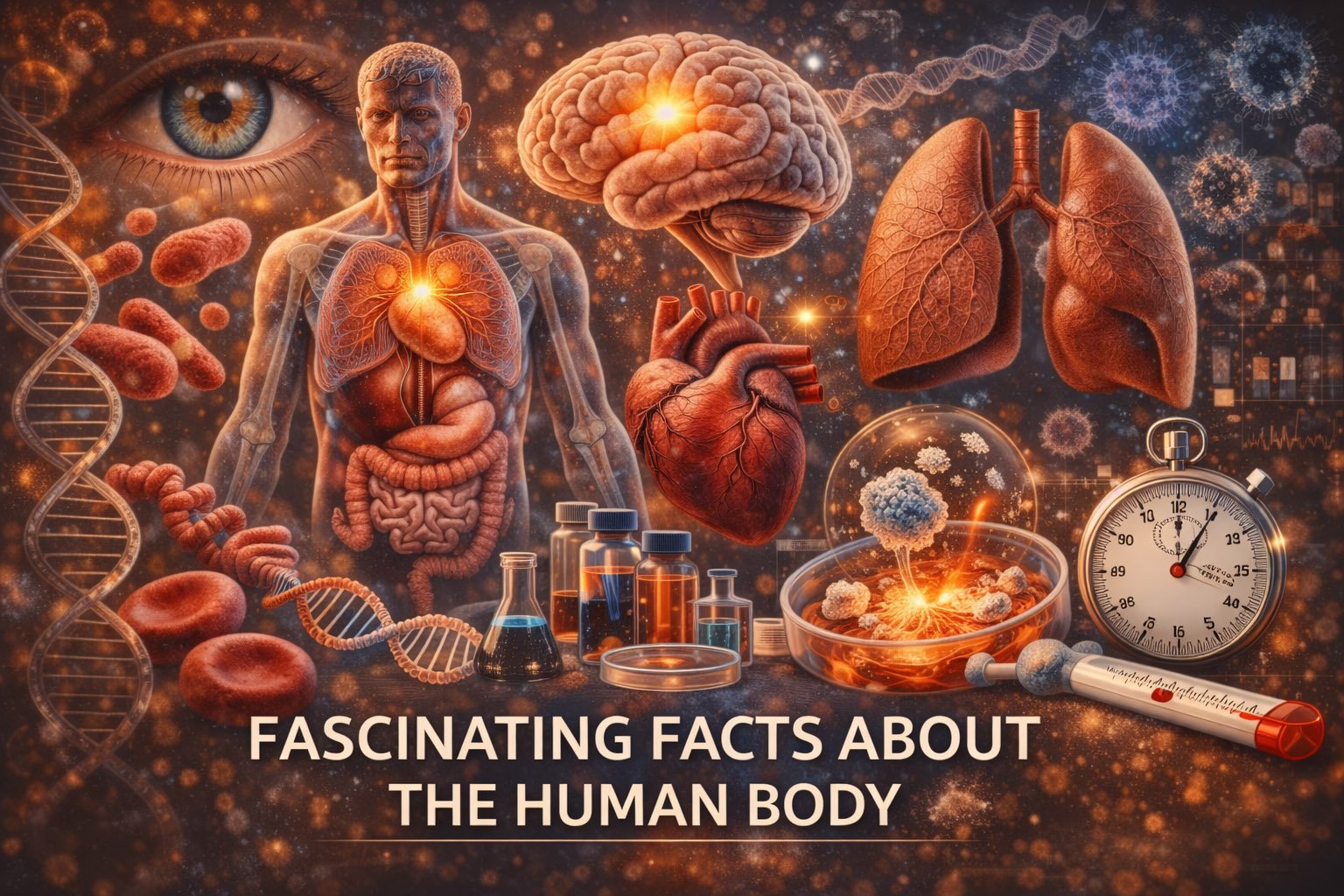
Fascinating Facts About the Human Body
The Hidden Complexity, Efficiency, and Resilience of the Human Organism
VitaCoreBalance Editorial Team | Research-based health content • Editorial review process | March 2026
The human body is one of the most sophisticated biological systems ever observed. It is not merely a collection of organs and tissues but an integrated network of chemical reactions, electrical signals, mechanical processes, and adaptive responses that operate continuously throughout life.
Every second, trillions of cells communicate, repair damage, regulate temperature, produce energy, and defend against threats. Most of these processes occur silently and automatically, without conscious awareness. Understanding these mechanisms reveals not only how the body works, but also how remarkably resilient and efficient it truly is.
This article explores scientifically verified and medically relevant facts about the human body—focusing on physiology, adaptation, survival mechanisms, and biological performance.
The Human Body Is Mostly Water — But Not Uniformly
Water is the dominant component of the human body, accounting for approximately:
- 60% of total body weight in adults
- Up to 75% in infants
- About 50% in older adults
However, water distribution is not equal across tissues.
Water Content by Organ
- Brain: ~73%
- Heart: ~73%
- Lungs: ~83%
- Muscles: ~79%
- Skin: ~64%
- Bones: ~31%
Water serves critical physiological functions:
- Transporting nutrients and oxygen
- Regulating temperature
- Supporting chemical reactions
- Removing metabolic waste
- Maintaining blood pressure
- Lubricating joints
Even small reductions in hydration can significantly affect performance.
Dehydration Effects
A loss of:
- 1–2% body water → Reduced concentration and alertness
- 3–4% body water → Decreased physical performance
- 5% or more → Risk of heat exhaustion and medical complications
Hydration is therefore not only about comfort—it is essential for survival and optimal physiological function.
The Brain Uses Massive Energy — Despite Its Size
The human brain weighs only about:
1.3 to 1.4 kilograms (2–3 pounds)
Yet it consumes approximately:
- 20% of total oxygen
- 20% of total energy
- 25% of glucose
This disproportionate energy demand reflects the brain’s role as the central control system of the body.
The brain:
- Processes sensory input
- Controls movement
- Regulates hormones
- Maintains temperature
- Coordinates memory and learning
- Manages emotional responses
- Controls automatic functions like breathing and heart rate
Continuous Activity
The brain never shuts down.
Even during sleep:
- Memory consolidation occurs
- Hormones are released
- Tissue repair is coordinated
- Neural connections are reorganized
Sleep is therefore an active biological state, not a passive one.
The Human Heart Generates Powerful Mechanical Force
The heart is a muscular pump that operates continuously from before birth until death.
Average lifetime performance:
- ~100,000 beats per day
- ~35 million beats per year
- ~2.5 to 3 billion beats in a lifetime
Each beat generates enough pressure to circulate blood throughout the body.
Daily Circulation
The heart pumps approximately:
- 7,000 to 8,000 liters of blood per day
- Over 2 million liters per year
Blood vessels form an extensive network.
If laid end to end, the total length of human blood vessels would be:
About 100,000 kilometers (62,000 miles)
This distance is:
More than twice the circumference of the Earth.
The Human Skeleton Is Constantly Rebuilding Itself
Bones appear rigid and permanent, but they are biologically active tissues that continuously change.
This process is called:
Bone remodeling
Two types of cells control bone structure:
Osteoclasts
— Break down old bone tissue
Osteoblasts
— Build new bone tissue
Complete Renewal
The adult skeleton:
Renews itself approximately every 10 years
This constant renewal allows bones to:
- Repair microscopic damage
- Adapt to physical stress
- Maintain mineral balance
- Preserve structural strength
Bone health depends heavily on:
- Physical activity
- Calcium intake
- Vitamin D
- Hormonal balance
The Skin Is the Body’s Largest Organ
The skin covers the entire external surface of the body and performs multiple protective and regulatory functions.
Average adult skin characteristics:
- Weight: 3 to 4 kilograms
- Surface area: 1.5 to 2 square meters
- Thickness: 0.5 to 4 millimeters
Functions of the Skin
The skin:
- Protects against infection
- Prevents fluid loss
- Regulates temperature
- Produces vitamin D
- Detects touch, pressure, and pain
- Shields against ultraviolet radiation
It also constantly renews itself.
Skin Renewal
The outer layer of skin:
Replaces itself approximately every 28 days
Dead skin cells are continuously shed and replaced by new ones produced in deeper layers.
The Immune System Is Always Active — Even When You Feel Healthy
The immune system operates continuously, detecting and neutralizing threats.
Every day, the human body encounters:
- Viruses
- Bacteria
- Fungi
- Environmental toxins
- Damaged cells
- Cancerous mutations
Most of these threats are eliminated before symptoms appear.
White Blood Cells: The Body’s Defense Force
White blood cells:
- Patrol the bloodstream
- Identify foreign substances
- Destroy infected cells
- Coordinate immune responses
- Produce antibodies
The immune system also has memory.
After exposure to a pathogen, the body can respond faster and more effectively if exposed again.
This principle is the foundation of:
Vaccination.
The Digestive System Produces Strong Acids
The stomach produces hydrochloric acid strong enough to dissolve many biological materials.
Stomach acid:
- Has a pH between 1.5 and 3.5
- Breaks down proteins
- Kills harmful microbes
- Activates digestive enzymes
Despite its strength, the stomach protects itself.
Protective Mechanism
The stomach lining produces:
Mucus.
This thick protective layer prevents acid from damaging stomach tissue.
If this protection fails, conditions may develop such as:
- Gastritis
- Peptic ulcers
- Acid reflux
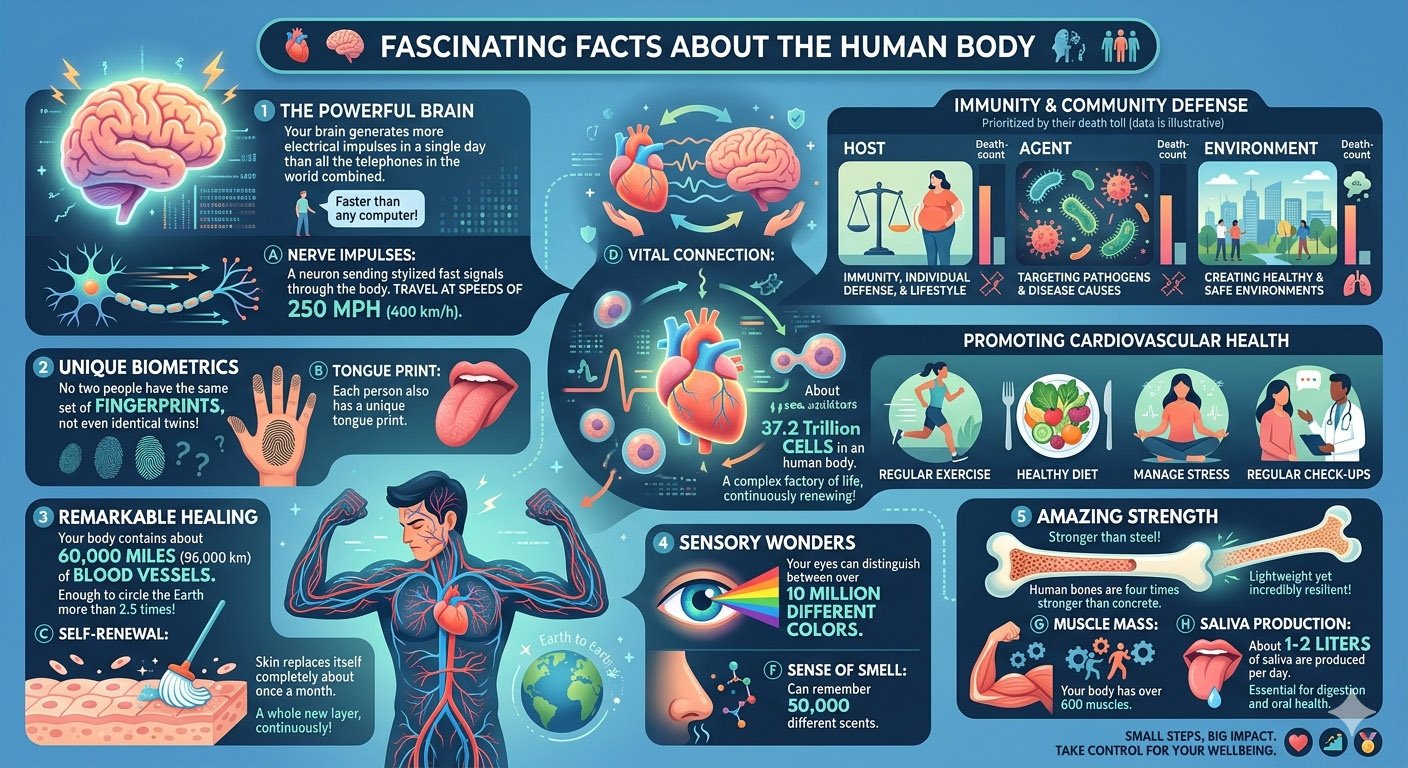
The Human Body Generates Electricity
The body uses electrical signals to communicate between cells and control movement.
Nervous System Signaling
Nerve impulses:
- Travel up to 120 meters per second
- Coordinate muscle contraction
- Control reflexes
- Process sensory information
- Regulate organ function
These electrical signals are measurable.
Medical devices that detect them include:
Electrocardiogram (ECG)
— Measures heart activity
Electroencephalogram (EEG)
— Measures brain activity
The Liver Is the Body’s Chemical Processing Center
The liver is one of the most versatile organs in the body.
It performs:
More than 500 known functions.
Key Functions
The liver:
- Detoxifies harmful substances
- Produces bile for digestion
- Stores vitamins and minerals
- Regulates blood sugar
- Produces essential proteins
- Breaks down medications
- Filters toxins from blood
Regeneration Ability
The liver has a unique capability:
It can regenerate lost tissue
Even if:
Up to 70% of the liver is removed
The remaining portion can grow back to its original size under the right conditions.
Few organs in the human body have this level of regenerative capacity.
The Body Constantly Replaces Its Cells
The human body is not static.
It is continuously renewing itself.
Estimated Cell Turnover
Each day, the body replaces:
50 to 70 billion cells
Examples:
Red blood cells
— Replaced every 120 days
Skin cells
— Replaced every 2–4 weeks
Intestinal lining cells
— Replaced every 3–5 days
This renewal process:
- Repairs damage
- Maintains function
- Prevents disease
- Supports healing
The Human Body Can Survive Extreme Conditions — Within Limits
The body has powerful mechanisms to maintain stability.
This stability is called:
Homeostasis.
Homeostasis regulates:
- Body temperature
- Blood pressure
- Blood sugar
- Oxygen levels
- Fluid balance
- Hormone levels
Temperature Regulation
Normal body temperature:
About 37°C (98.6°F)
The body maintains this temperature through:
Sweating
— Releases heat
Shivering
— Generates heat
Blood vessel dilation
— Releases heat
Blood vessel constriction
— Conserves heat
These responses occur automatically and rapidly.
The Body Is a Self-Repairing System
One of the most remarkable features of the human body is its ability to repair itself.
Healing Process
When tissue is injured, the body initiates a coordinated response:
Step 1 — Blood clotting stops bleeding
Step 2 — Inflammation removes damaged cells
Step 3 — New tissue forms
Step 4 — Tissue strengthens and remodels
This process can occur:
- In skin
- In muscles
- In bones
- In internal organs
Healing speed depends on:
- Nutrition
- Age
- Sleep quality
- Circulation
- Immune function
- Overall health
Conclusion
The human body is not simply a biological structure—it is a dynamic, adaptive, self-regulating system capable of extraordinary performance and resilience. Every moment, complex processes operate beneath conscious awareness, maintaining balance, repairing damage, and protecting life.
Understanding these physiological mechanisms is more than a matter of curiosity. It provides insight into health, disease prevention, and the conditions necessary for long-term survival and well-being.
The more we learn about the human body, the clearer it becomes:
Its true complexity lies not only in its structure, but in its ability to adapt, recover, and sustain life under constantly changing conditions.
Medical Disclaimer
This content is for informational purposes only and does not constitute medical advice. Always consult a qualified healthcare professional.
Editorial Transparency
This article was created following evidence-based health content guidelines and reviewed by the VitaCoreBalance Editorial Team.
Sources
World Health Organization (WHO)
https://www.who.int
National Institutes of Health (NIH)
https://www.nih.gov
MedlinePlus
https://medlineplus.gov
Cleveland Clinic
https://my.clevelandclinic.org
Mayo Clinic
https://www.mayoclinic.org
Encyclopaedia Britannica
https://www.britannica.com