
L-Glutamine for Gut and Overall Health

VitaCoreBalance Editorial Team | Research-based health content · Editorial review process | March 2026 – Updated April
How L-Glutamine Supports Intestinal Integrity, Recovery, and Metabolic Function
L-Glutamine is the most abundant amino acid in the human body and plays a central role in tissue repair, immune function, and digestive health. It is particularly important for maintaining the integrity of the intestinal lining and supporting recovery during periods of physical stress.
The body naturally produces glutamine, but demand may increase during illness, intense physical activity, injury, or metabolic stress. In these situations, supplementation may help support tissue repair, immune balance, and digestive function.
L-Glutamine is widely used in clinical nutrition, sports performance, and gastrointestinal support because of its role in cellular repair and metabolic stability.
What Is L-Glutamine?
A Key Amino Acid for Tissue Repair and Intestinal Health
L-Glutamine is a conditionally essential amino acid that serves as a primary fuel source for intestinal cells and immune cells. It helps maintain the structure of the gut lining and supports recovery during physiological stress.
This amino acid plays an important role in:
- Intestinal barrier integrity
- Tissue repair
- Immune system function
- Protein synthesis
- Muscle recovery
- Metabolic balance
- Nitrogen transport
- Cellular energy production
Because of these functions, glutamine is widely used in both clinical and wellness settings.
Benefits of L-Glutamine
Supports Intestinal Health, Recovery, and Physiological Resilience
1) Supports Intestinal Barrier Integrity
L-Glutamine serves as a primary energy source for cells lining the intestinal wall.
It may help support:
- Gut lining integrity
- Intestinal barrier function
- Digestive stability
- Nutrient absorption
Maintaining the gut barrier is essential for digestive and immune health.
2) Supports Digestive Health and Recovery
Glutamine plays a role in maintaining digestive system function.
It may help support:
- Digestive comfort
- Gastrointestinal recovery
- Nutrient utilization
- Digestive resilience
Digestive stability supports overall wellness.
3) Supports Immune System Function
Immune cells use glutamine as a major fuel source.
L-Glutamine may help support:
- Immune response
- Immune resilience
- Infection recovery
- Inflammatory balance
Immune support is closely linked to nutritional status.
4) Supports Muscle Recovery and Physical Performance
Glutamine supports protein synthesis and muscle repair.
It may help support:
- Muscle recovery
- Exercise recovery
- Reduced muscle breakdown
- Physical resilience
These effects are particularly relevant during intense physical activity.

5) Supports Metabolic and Energy Function
Glutamine participates in metabolic processes and energy production.
It may help support:
- Cellular energy production
- Metabolic stability
- Nutrient metabolism
- Recovery from physical stress
Efficient metabolism supports overall health.
6) Supports Stress Recovery
Physiological stress increases glutamine demand.
L-Glutamine may help support:
- Recovery from illness
- Recovery from surgery
- Physical recovery
- Immune balance
Stress recovery is an important component of long-term health.
7) Supports Overall Wellness
L-Glutamine contributes to multiple physiological systems.
It may support:
- Digestive health
- Immune resilience
- Tissue repair
- Energy balance
- General well-being
Glutamine is widely used in clinical and wellness nutrition.
Who May Benefit from L-Glutamine
L-Glutamine supplementation may be beneficial for individuals experiencing increased physiological demand or digestive stress.
Common groups include:
Individuals with digestive discomfort
People experiencing gastrointestinal stress
Athletes and physically active individuals
Individuals recovering from illness or surgery
People under high physical or metabolic stress
Older adults
Individuals seeking immune support
People with high training intensity
Individuals seeking recovery support
Demand for glutamine may increase during stress and recovery.
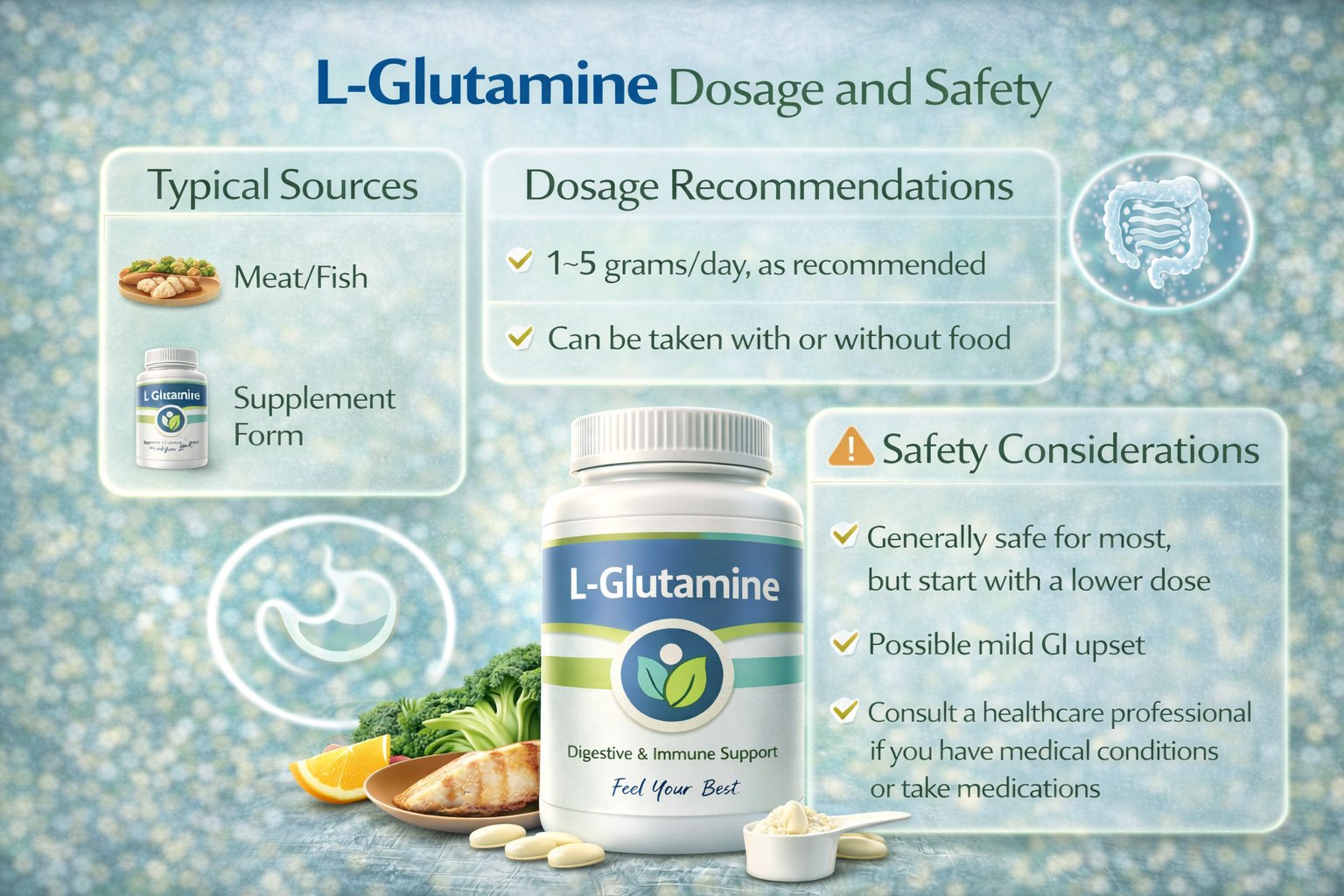
Safety and Dosage
Recommended Intake and Safe Supplementation
Typical Daily Intake
General support:
5 grams per day
Digestive or recovery support:
5 to 10 grams per day
Higher amounts may be used under professional guidance.
Best Time to Take L-Glutamine
Common timing includes:
Between meals
After exercise
In the morning
Before bedtime
Consistency is important for effectiveness.
Possible Side Effects
L-Glutamine is generally well tolerated.
Possible mild effects may include:
Digestive discomfort
Bloating
Nausea
These effects are usually temporary.
Safety Considerations
Consult a healthcare professional before use if:
Kidney disease is present
Liver disease is present
Taking specialized medical treatments
Pregnant or breastfeeding
Most healthy adults tolerate L-glutamine safely.
Evidence and Research
Scientific research supports the role of glutamine in intestinal health, immune function, and recovery.
Clinical studies show that L-glutamine supplementation may:
Support intestinal barrier function
Improve recovery during physiological stress
Enhance immune response
Support muscle recovery
Improve metabolic resilience
Support clinical nutrition outcomes
Glutamine is widely studied in sports nutrition and clinical medicine.
Best Supplements
Common Forms of L-Glutamine Supplements
L-Glutamine Powder
Most common form
Flexible dosing
Fast absorption
Capsule or Tablet Form
Convenient daily use
Pre-measured dosage
Recovery and Performance Formulas
Often combined with:
Electrolytes
Amino acids
Protein blends
Used in sports and recovery settings.
FAQ
What does L-glutamine help with?
L-Glutamine supports intestinal health, immune function, muscle recovery, and overall physiological resilience.
Is L-glutamine good for gut health?
Yes. L-glutamine is an important fuel source for intestinal cells and helps maintain gut lining integrity.
Can I take L-glutamine every day?
Yes. L-glutamine is commonly used as part of a daily routine to support recovery and digestive health.
How long does L-glutamine take to work?
Some individuals notice improvements within:
Several days
More consistent benefits typically develop within:
2 to 4 weeks
Is L-glutamine safe for long-term use?
L-glutamine is generally considered safe for long-term use when taken as directed.
Medical Disclaimer
This content is for informational purposes only and does not constitute medical advice. Always consult a qualified healthcare professional.
Editorial Transparency
This article was created following evidence-based health content guidelines and reviewed by the VitaCoreBalance Editorial Team.
SOURCES:
- National Institutes of Health (NIH) — Glutamine
https://www.ncbi.nlm.nih.gov/books/NBK554498/ - Cleveland Clinic — Glutamine: What It Is and Benefits
https://health.clevelandclinic.org/glutamine-benefits/ - Mayo Clinic — Glutamine (Oral Route)
https://www.mayoclinic.org/drugs-supplements/glutamine-oral-route/description/drg-20064099 - Mount Sinai — Glutamine
https://www.mountsinai.org/health-library/supplement/glutamine - Journal of Parenteral and Enteral Nutrition — Glutamine in Clinical Nutrition
https://aspenjournals.onlinelibrary.wiley.com/doi/10.1002/jpen.1454 - National Library of Medicine (PubMed) — Glutamine and Intestinal Health
https://pubmed.ncbi.nlm.nih.gov/26201814/